

How To Find Supremum And Infimum Of A Set

A set of real numbers (hollow and filled circles), a subset of (filled circles), and the infimum of Note that for finite, totally ordered sets the infimum and the minimum are equal.


A set of real numbers (blue circles), a gear up of upper bounds of (carmine diamond and circles), and the smallest such upper spring, that is, the supremum of (red diamond).

In mathematics, the infimum (abbreviated inf; plural infima) of a subset of a partially ordered set is a greatest element in that is less than or equal to all elements of if such an chemical element exists.[1] Consequently, the term greatest lower bound (abbreviated equally GLB) is also ordinarily used.[1]

The supremum (abbreviated sup; plural suprema) of a subset of a partially ordered set is the to the lowest degree element in that is greater than or equal to all elements of if such an chemical element exists.[ane] Consequently, the supremum is also referred to every bit the least upper bound (or LUB).[1]
The infimum is in a precise sense dual to the concept of a supremum. Infima and suprema of existent numbers are common special cases that are important in analysis, and peculiarly in Lebesgue integration. However, the general definitions remain valid in the more abstruse setting of social club theory where arbitrary partially ordered sets are considered.
The concepts of infimum and supremum are shut to minimum and maximum, but are more than useful in assay because they meliorate narrate special sets which may accept no minimum or maximum. For instance, the set of positive existent numbers (not including ) does not have a minimum, considering whatsoever given element of could simply be divided in half resulting in a smaller number that is still in There is, withal, exactly 1 infimum of the positive real numbers: which is smaller than all the positive real numbers and greater than any other real number which could be used as a lower spring.


Formal definition [edit]

supremum = least upper leap
A lower jump of a subset of a partially ordered fix is an element of such that


A lower bound of is called an infimum (or greatest lower bound, or meet) of if
Similarly, an upper spring of a subset of a partially ordered set is an chemical element of such that

An upper bound of is called a supremum (or least upper bound, or bring together) of if
Beingness and uniqueness [edit]
Infima and suprema do non necessarily exist. Existence of an infimum of a subset of can fail if has no lower bound at all, or if the set of lower premises does not comprise a greatest element. Yet, if an infimum or supremum does exist, it is unique.
Consequently, partially ordered sets for which certain infima are known to exist become especially interesting. For instance, a lattice is a partially ordered fix in which all nonempty finite subsets take both a supremum and an infimum, and a complete lattice is a partially ordered gear up in which all subsets have both a supremum and an infimum. More than information on the various classes of partially ordered sets that arise from such considerations are found in the article on completeness backdrop.
If the supremum of a subset exists, it is unique. If contains a greatest element, then that chemical element is the supremum; otherwise, the supremum does non belong to (or does not exist). Too, if the infimum exists, it is unique. If contains a to the lowest degree element, then that element is the infimum; otherwise, the infimum does non belong to (or does non exist).
Relation to maximum and minimum elements [edit]
The infimum of a subset of a partially ordered fix assuming information technology exists, does non necessarily belong to If information technology does, it is a minimum or to the lowest degree element of Similarly, if the supremum of belongs to it is a maximum or greatest element of

For instance, consider the gear up of negative real numbers (excluding nil). This set has no greatest element, since for every element of the set, in that location is some other, larger, element. For example, for any negative real number there is another negative real number which is greater. On the other hand, every real number greater than or equal to zippo is certainly an upper bound on this ready. Hence, is the least upper bound of the negative reals, and then the supremum is 0. This set up has a supremum merely no greatest element.


Notwithstanding, the definition of maximal and minimal elements is more general. In item, a set tin can have many maximal and minimal elements, whereas infima and suprema are unique.
Whereas maxima and minima must be members of the subset that is under consideration, the infimum and supremum of a subset demand not be members of that subset themselves.
Minimal upper premises [edit]
Finally, a partially ordered set up may take many minimal upper bounds without having a least upper bound. Minimal upper bounds are those upper bounds for which in that location is no strictly smaller element that besides is an upper jump. This does non say that each minimal upper bound is smaller than all other upper bounds, it simply is not greater. The stardom between "minimal" and "least" is but possible when the given order is not a total i. In a totally ordered set, like the real numbers, the concepts are the aforementioned.
As an example, let be the prepare of all finite subsets of natural numbers and consider the partially ordered set obtained by taking all sets from together with the set of integers and the set of positive existent numbers ordered by subset inclusion equally above. And then clearly both and are greater than all finite sets of natural numbers. Withal, neither is smaller than nor is the antipodal true: both sets are minimal upper bounds but none is a supremum.


To the lowest degree-upper-bound property [edit]
The least-upper-bound holding is an instance of the same completeness properties which is typical for the set of real numbers. This belongings is sometimes called Dedekind completeness.
If an ordered set has the property that every nonempty subset of having an upper bound likewise has a least upper bound, and then is said to have the to the lowest degree-upper-bound property. As noted above, the set of all real numbers has the to the lowest degree-upper-bound property. Similarly, the set of integers has the least-upper-bound property; if is a nonempty subset of and at that place is some number such that every element of is less than or equal to then there is a least upper leap for an integer that is an upper spring for and is less than or equal to every other upper bound for A well-ordered set up likewise has the least-upper-bound property, and the empty subset has also a to the lowest degree upper bound: the minimum of the whole gear up.


An example of a set up that lacks the least-upper-bound holding is the fix of rational numbers. Let be the prepare of all rational numbers such that 


There is a corresponding greatest-lower-leap belongings; an ordered set possesses the greatest-lower-bound belongings if and only if it also possesses the least-upper-bound property; the to the lowest degree-upper-spring of the ready of lower bounds of a set is the greatest-lower-leap, and the greatest-lower-bound of the fix of upper premises of a set is the least-upper-bound of the set.
If in a partially ordered set every divisional subset has a supremum, this applies too, for any set in the function infinite containing all functions from to where if and only if for all For case, it applies for real functions, and, since these can be considered special cases of functions, for real -tuples and sequences of real numbers.


The least-upper-bound holding is an indicator of the suprema.
Infima and suprema of existent numbers [edit]
In analysis, infima and suprema of subsets of the real numbers are particularly important. For instance, the negative real numbers practise not have a greatest chemical element, and their supremum is (which is non a negative real number).[1] The completeness of the existent numbers implies (and is equivalent to) that whatsoever bounded nonempty subset of the real numbers has an infimum and a supremum. If is not divisional below, one often formally writes If is empty, one writes


Properties [edit]
The following formulas depend on a notation that conveniently generalizes arithmetic operations on sets: Let the sets and scalar Define


- if and merely if and otherwise [2]
- ; the scalar product of a prepare is just the scalar multiplied past every element in the set.
- ; called the Minkowski sum, it is the arithmetic sum of 2 sets is the sum of all possible pairs of numbers, one from each set.
- ; the arithmetic product of ii sets is all products of pairs of elements, one from each set.
- If then there exists a sequence in such that Similarly, in that location will exist a (perchance different) sequence in such that Consequently, if the limit is a existent number and if is a continuous part, then is necessarily an adherent point of







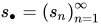
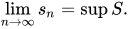

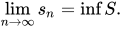
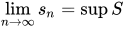


In those cases where the infima and suprema of the sets and exist, the following identities hold:

Duality [edit]
If 1 denotes by the partially-ordered set with the contrary lodge relation; that is, for all declare:



and then infimum of a subset in equals the supremum of in and vice versa.
For subsets of the real numbers, another kind of duality holds: where


Examples [edit]
Infima [edit]
- The infimum of the set of numbers is The number is a lower bound, but not the greatest lower spring, and hence non the infimum.
- More mostly, if a set has a smallest element, then the smallest element is the infimum for the ready. In this example, it is as well chosen the minimum of the set.
-
- If is a decreasing sequence with limit then




![{\displaystyle \inf \left\{x\in \mathbb {Q} :x^{3}>2\right\}={\sqrt[{3}]{2}}.}](https://wikimedia.org/api/rest_v1/media/math/render/svg/426d2eb56064e9fe795284a944ced4ac871473c8)



Suprema [edit]
- The supremum of the set of numbers is The number is an upper bound, merely information technology is not the to the lowest degree upper bound, and hence is not the supremum.
-






In the last case, the supremum of a gear up of rationals is irrational, which ways that the rationals are incomplete.
1 bones property of the supremum is

for any functionals and


The supremum of a subset of where denotes "divides", is the lowest common multiple of the elements of


The supremum of a subset of where is the power prepare of some ready, is the supremum with respect to (subset) of a subset of is the union of the elements of


See also [edit]
- Essential supremum and essential infimum
- Greatest element and least chemical element – Chemical element ≥ (or ≤) each other element
- Maximal and minimal elements – Element that is not ≤ (or ≥) whatever other element
- Limit superior and limit inferior (infimum limit)
- Upper and lower premises – Majorant and minorant in mathematics
Notes [edit]
References [edit]
- ^ a b c d e Rudin, Walter (1976). ""Chapter one The Real and Circuitous Number Systems"". Principles of Mathematical Analysis (print) (3rd ed.). McGraw-Colina. p. iv. ISBN0-07-054235-10.
- ^ Rockafellar & Wets 2009, pp. 1–two. sfn fault: no target: CITEREFRockafellarWets2009 (aid)
- ^ Zakon, Elias (2004). Mathematical Assay I. Trillia Grouping. pp. 39–42.
- Rockafellar, R. Tyrrell; Wets, Roger J.-B. (26 June 2009). Variational Assay. Grundlehren der mathematischen Wissenschaften. Vol. 317. Berlin New York: Springer Science & Concern Media. ISBN9783642024313. OCLC 883392544.
External links [edit]
- "Upper and lower bounds", Encyclopedia of Mathematics, European monetary system Press, 2001 [1994]
- Breitenbach, Jerome R. & Weisstein, Eric W. "Infimum and supremum". MathWorld.

How To Find Supremum And Infimum Of A Set,
Source: https://en.wikipedia.org/wiki/Infimum_and_supremum
Posted by: odellbrolud.blogspot.com
0 Response to "How To Find Supremum And Infimum Of A Set"
Post a Comment